Home / Fluid Dynamics Research / Mobility Tensor Quantification
Mobility Tensor Quantification
A senior thesis on understanding how shape affects motion, so we can make particles move as designed.

I've been a research assistant in the Voth Group (Fluid Dynamics and Soft Matter Lab) since my freshman spring. I design, 3D print, and analyze helical particles sedimenting through both turbulent high Reynolds number, and low Reynolds number Stokes flow.
Now, I'm writing a senior thesis on measuring how their geometry affects the way particles fall, and how we can design them to move as we want.
A mobility tensor ties a particle's motion to the forces on it. They are entirely determined by the shape of the particle. I built a high-accuracy particle tracking workflow, which, in combination with a precise model for forces and torques on our particles, made our group the first to ever experimentally measure the full set of relevant mobility tensors for a complex sedimenting particle.
Gallery
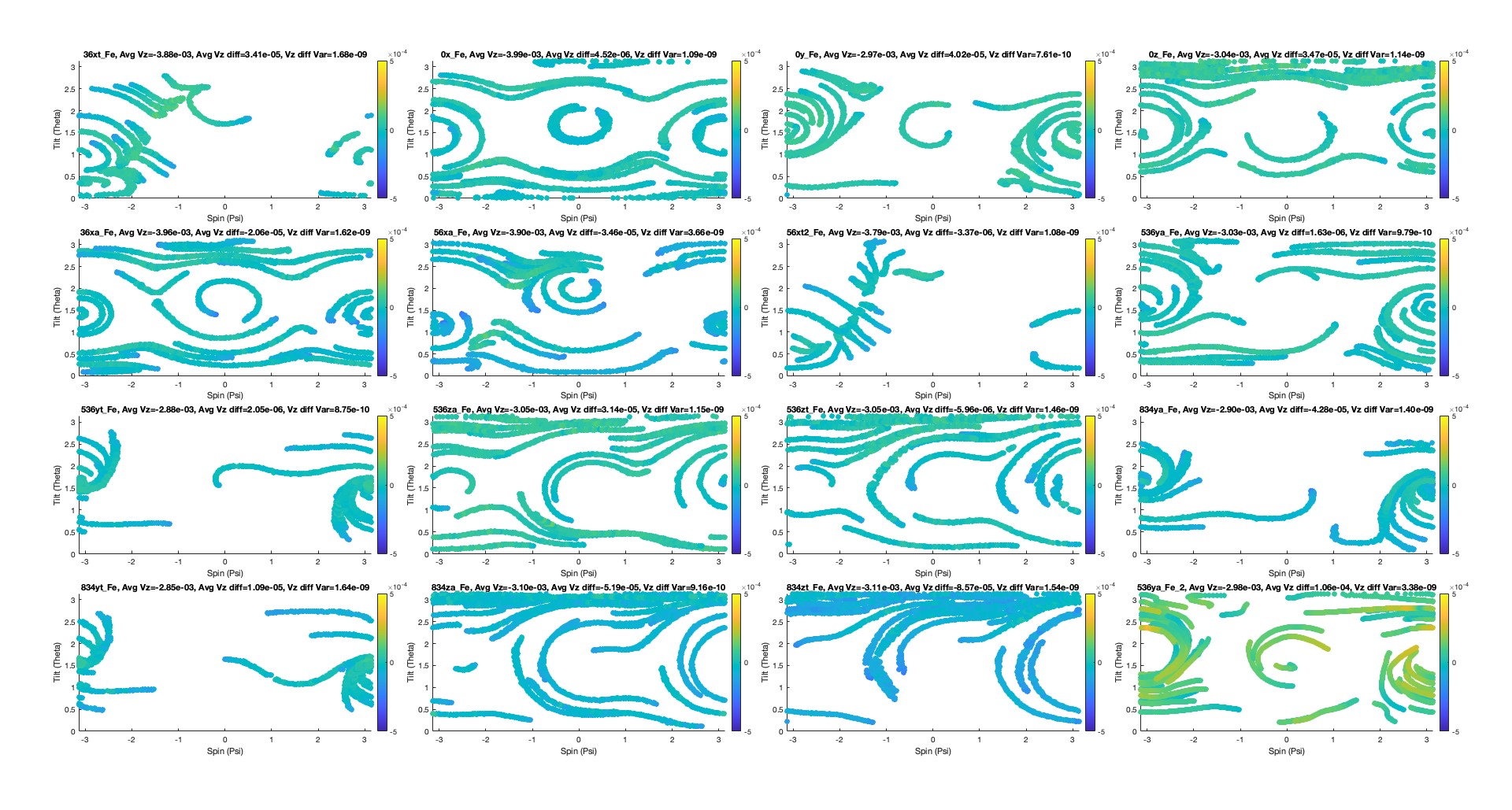
Velocity Differences
These graphs encode the dynamics of different particles that we tracked. The color shows the difference in velocities between our predictions and our data, essentially showing the quality of our experimental mobility tensors. They show that, on average, our mobility tensors mispredict velocities by about 5 microns/second, where average velocities are about 4mm/second.