Home / Fluid Dynamics Research / Sedimentation of the Chaotic Helical Ribbon (PHYS 217)
Sedimentation of the Chaotic Helical Ribbon (PHYS 217)
A mini-project to explore chaos in low reynolds number sedimentation
In this project, a research group partner and I explored adding a temporal degree of freedom to the center of mass of a particle our research group uses routinely, in an attempt to see if we could nucleate chaotic dynamics in Stokes flow sedimentation. We found that our particle is extremely sensitive to center of mass offsets and the chaotic dynamics were present, achievable, and extremely interesting.
In simple sedimentation, our system can be described by two degrees of freedom- tilt and spin. By introducing time-dependent oscillations of the center of mass, we create a third degree of freedom due to changing gravitational torques. We explored the routes to chaos by simulating oscillating the center of mass along all three principal axes, at different frequencies, and at different amplitudes.
We analyzed the results for Lyapunov exponents, and applied these findings to our overarching researrch goal of designing particles to have specific sedimentation characteristics.
Gallery
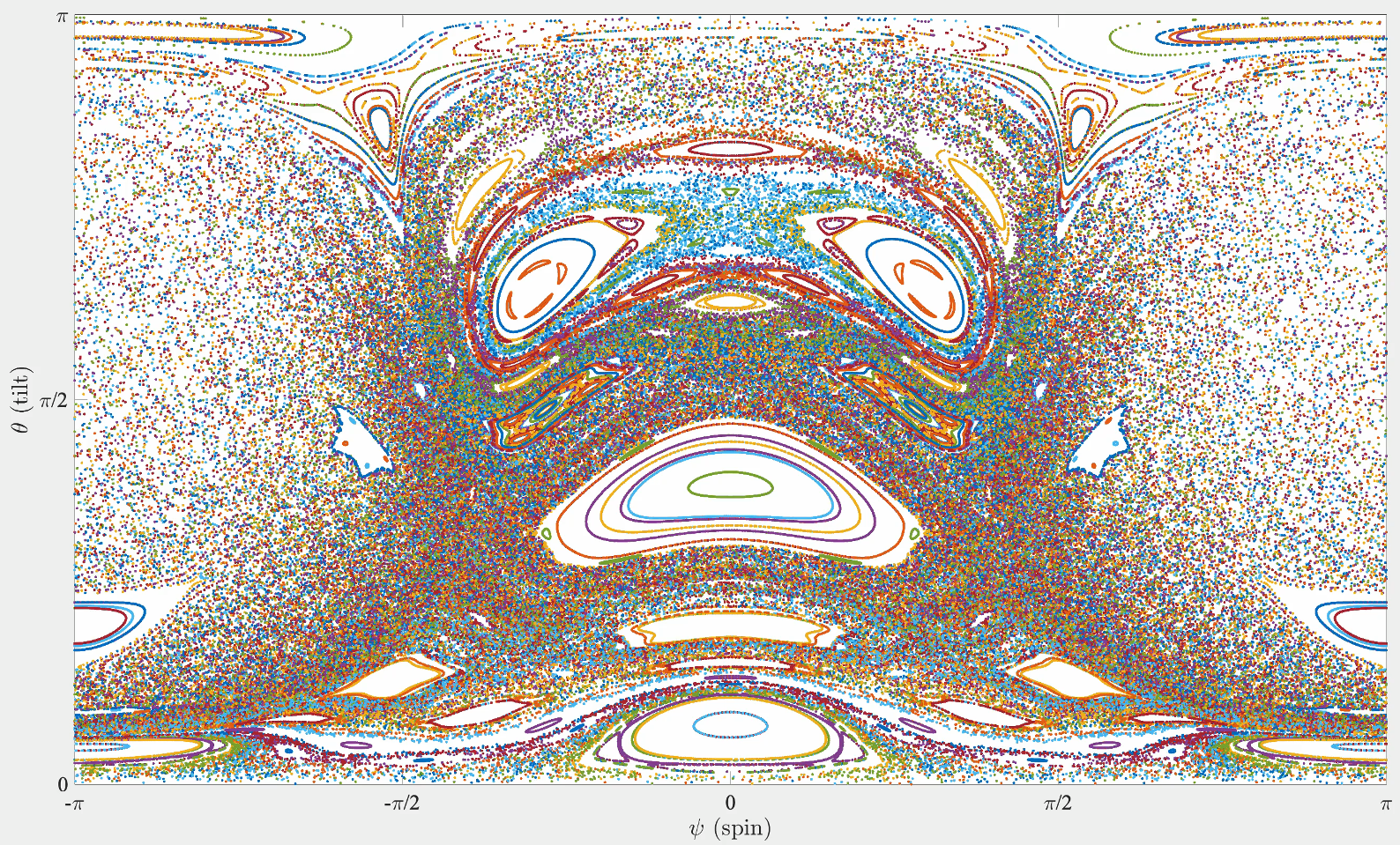
Phase space of the chaotic sedimenting helical ribbon
This image won the Wesleyan CIS image prize in 2025. This graph shows the tilt-spin dynamics of the helical ribbon. The regions with smooth curves are "regular". The particle will simply oscillate as it falls with its tilt and spin tracing the closed loops. The intricate structure of the closed loops reveals fractals in phase space dynamics as one zooms further in through the regular regions. The regions filled with dots are chaotic, where the particle has unpredictable, erratic motion.